Read a timely quote from Ovid, a Roman poet who lived in the first century C.E.:
Time is usually the best medicine10.3.12
Quotation On Time by Ovid


 I am an educator and a writer. I was born in Louisiana and I now live in the Big Apple. My heart beats to the rhythm of "Ain't No Place to Pee on Mardi Gras Day". My style is of the hot sauce variety. I love philosophy sprinkles and a hot cup of café au lait.
27.2.12
On Realism and Strunk and White: Rule 16 On Writing
I write about, in this post, the famous book the Elements of Style - one of the few editorial style books to make it to the bestseller list.
I live by this rule of writing:
Rule 16: "Prefer the specific to the general, the definite to the vague, the concrete to the abstract" (pg. 21).
 |
| Find my TpT store here and be amazed. |
Most of my adult life I lived amidst the company of other people's books. Now that I am free from the prescriptions of communal living I find myself purchasing books that I never in the past had to own. Strunk and White is one such book.
I am an educator and a writer. I was born in Louisiana and I now live in the Big Apple. My heart beats to the rhythm of "Ain't No Place to Pee on Mardi Gras Day". My style is of the hot sauce variety. I love philosophy sprinkles and a hot cup of café au lait.
14.2.12
Reflecting On Despair According to Søren Kierkegaard (and Others)

Must we despair in order that we don’t despair?
Must we suffer, so as not to suffer? We find ourselves in a paradox, stuck between finitude and infinitude, wanting to die and not wanting to die. Life can be artificial oftentimes — death has already struck us a blow, a death that is more internal and threatens the infinite more than any physical death could. Every day we face ourselves; we face our possibilities, sometimes cringing and other times barely aware that we are sad.
Søren Kierkegaard experienced despair. The words he writes on the subject reek of subjectivity; you can almost taste-smell-touch Kierkegaard’s despair as you read a work like the Sickness Unto Death.
Kierkegaard never claims to be someone whose been “transparent before God”; he probably never was “healthy and free” from despair — for he says all of us whether we are Christian or not, have despaired or continue to despair.
There are probably many events in Kierkegaard’s life that disrupted his own synthesis of infinitude and infinitude.
Kierkegaard's Failed Romance with Regina Olsen
Kierkegaard fell in love with a young woman named Regina Olsen. There is no doubt that many of the works produced by Kierkegaard were a result of the relationship he had with her.
They were planning marriage until Kierkegaard decided to end the relationship. It seems when great happiness is evident, or the possibility of happiness is on the horizon, despair settles in deepest. In the Moviegoer Walker Percy’s character Binx Bolling makes that clear in the Moviegoer when he says, “whenever one courts great happiness, one also risks malaise” (121).
Kierkegaard had straddled that possibility and it made him afraid; he didn’t fall out of love with Regina Olsen (he loved her dearly — till his death). When he broke off the engagement with her he made sure she did not suffer embarrassment. In Kierkegaard's time, if a man breaks off an engagement with a woman, the woman is stigmatized. Kierkegaard prevented that stigma so he forced her to break off the engagement with him. He made sure friends and family saw him as the villain and Regina as the victim. He quit seeing her; he quit sending flowers; he quit courting her.
Why did he do this? Obviously they would have been happy. What caused him to end such a relationship? Kierkegaard was afraid that if he married Regina Olsen, he would be unable to continue writing — he considered himself unsuited for the married life (Coppleston, Vol. 7, p. 338) — he was a man with goals and ideas and sealing a marriage, he felt, would prevent him from achieving his philosophical goals.
He alludes to the engagement in his writings; one gets the sense that he regretted his decision — that he gave up on a beautiful thing. He writes of the relationship, pseudonymously, in a wry, novel-like section of Either/Or or also called The Seducer’s Diary.
A few years before his engagement to Regina Olsen, he seriously considered suicide. Kierkegaard grew up in a strict, religious family. His father was a melancholic, religious man who believed that God’s wrath was imminent. The father’s dire religious overtones hung over the family like a doomsday saying. Kierkegaard's father read to his son stories from the bible from an illustrated tome that depicted graphically the violence of the crucifixion. I think the young Kierkegaard was seared by those images of a brutally beaten Christ hanging on a cross.
The Theme of Despair in the book The Sickness Unto Death
The central story of Sickness Unto Death is an interpretation of the rising of Lazarus by Christ recounted in Chapter 11 of John's Gospel. Lazarus, the brother of Martha and the Mary who anointed the body of Jesus with oil and dried his feet with her hair, is ill and near death. Kierkegaard reads the story as an explanation of despair. Christ says Lazarus's sickness is not unto death (John 11:4). The disciples misunderstand Jesus to mean physical death, but Jesus means spiritual death, the death caused by despair. Raising Lazarus from the dead is the greatest "sign" Christ performs in John's Gospel. In fact, it is the culmination event of many minor "signs" Jesus performs. Kierkegaard reads the story as an allegory on despair. Raising Lazarus from the dead is meant to serve a point: that death won't kill Lazarus. To raise him from the dead only for him to die, physically later on, is to suggest that Christ has saved him from the death caused by inner despair.
On a Recent Visit to Copenhagen I Visted Kierkegaard
On a Recent Visit to Copenhagen I Visted Kierkegaard
I wrote on Kierkegaard as an undergraduate philosophy major. I went to Copenhagen to visit his grave, which turned out to be a great pun for in Danish graveyard is "kierkegaard" so when I asked someone where was the grave of Kierkegaard they thought I was asking where was the churchyard. It is fitting that Kierkegaard's name means graveyard.
On my way to Copenhagen I took a ferry from Germany to Denmark in a train. The train enters the ferry via built-in tracks. It was late at night. I was sitting next to a German girl who was going to Denmark for a summer job. Since we were talking to each other, when the train boarded the ferry, we both went on deck to look out into the sea. I remember looking down into the dark wine waters and feeling vertigo and this sudden desire to plunge into the vortex.
Perhaps what Kierkegaard was trying to say is that we can die way before our actual deaths. Feeling the vertigo made me feel alive but at the same time hearkened a baleful note to my mortality. I recognized the horrific contingency of my being, that I won't last long. Kierkegaard's point was that we succumb to death long before we physically die in a kind of covering up of our selves. Famously Kierkegaard defines the self as a relation that is in relationship with its own self. Sometimes this relational structure becomes muddled, scratched over, hidden and we become lost to our self. We are unmoored from our relationship to our very self.
The greatest form of despair is the despair that does not even know it is in despair.
To know I am in despair is the first step to not be in despair. In other words, to know that I am born, introduced to this world without any instruction, or even with my permission, so I recognize that I am not at home in this world. To be in despair is to kid myself into thinking that I am at home in the world when really I am not.
Heidegger was influenced by Kierkegaard. What Heidegger has to say about anxiety is closely mirrored to Kierkegaard's theory of the self. Dasein (Heidegger's neologism for the human being, which means literally being-there) is a being whose very being becomes an issue for it. This is very close to what Kierkegaard was trying to say. And I think it is what Walker Percy was trying to say in all of his novels: we are strangers in a strange land.
That night on the ferry to Denmark I wanted to jump into the void for it promised an escape. Not that I had any external reason to be in despair. At that time in my life, I was feeling pretty good. But the recognition came to me that what defines the human being is despair.
The Mass of Men Leads Lives of Quiet Desperation
The Mass of Men Leads Lives of Quiet Desperation
I think it was Thoreau who said the mass of men lead lives of quiet desperation. I think he was onto something. And so was I at that moment. Since then I have forgotten. Only to find my notes on Kierkegaard in a notebook from my college days which I reconstructed to write this blog post. The me of 2000 when I was 20 is sending a message to me of 2012 at 32. I think that is how it works. There is no essential self. Just fragments. Thank god we can communicate.
I am an educator and a writer. I was born in Louisiana and I now live in the Big Apple. My heart beats to the rhythm of "Ain't No Place to Pee on Mardi Gras Day". My style is of the hot sauce variety. I love philosophy sprinkles and a hot cup of café au lait.
1.2.12
On the Experience of Reading Novels

The experience of reading novels is a solitary one. While it is common to hear authors read from their newly published books at signings or to listen to a novel on tape, these are subsidiary experiences of the novel that I relegate to the category of performance rather than reading. Orality is to the epic what solitude is to the novel. The Greek epics the Iliad and the Odyssey were not meant to be read silently to oneself but were told out loud and spun by a storyteller as part of an oral musical performance. Prose fiction did not begin with the novel; Satyricon was written centuries before Moll Flanders. Scholars debate as to what constitutes the first novel — is it Cervantes’s Don Quixote, or Chaucer’s Canterbury Tales, or is it Richardson’s Pamela, or DeFoe’s Robinson Crusoe? — I think the answer to this question lies in the shift between reading publicly versus reading as an internalized experience. The epics were meant as univocal expressions of storytelling governed by the principle of archetype and standard mythological rendering. Often the plot was well known by the hearers.
Reading Novels is Not Exactly the Same as Going to a Play
Ancient Greek theatergoers who attended Sophocles’ production of Oedipus Rex were well aware of the plot. And this is true even for Shakespeare. Midsummer Night’s Dream, while certainly not lost in an individual reading, the dramatic form, like the epic, is meant to be performed, not read. The point of storytelling has been for centuries a ritualized experience and not at all adumbrated by individuality or an experience with everyday particularities. To read a novel once is an individual experience and to read the same novel twice is yet another distinct reading. Even movies, another modern discovery, are more akin to public storytelling than what happens when I read a novel. Reading as an individualized personal experience is a modern discovery. Augustine, for example, was shocked to discover Ambrose reading to himself. In the West, reading has been considered mostly a public act. Those who owned books were either the clergy or the very wealthy. Books were proclaimed rather than read. The correlation between introspective thought and reading troubled Augustine because he did not equate reading with individuality. What we consider the modern novel is instantiated by introspection and was only made possible broadly by the invention of the printing press which made books cheaper and more easily accessible to the masses.
Novels Deliver the Particulars of the Everyday
Novels are heavily entrenched in the particulars of everyday life, such as bathing, doing the laundry, eating a sour grape off the vine, making love on an unmade bed, reflections on the banal and the mundane, and so on. The novel lingers in the details of everyday lived experience. The novel is a repudiation of the epic form’s dependence on universals. Once we are inside a novel we are wrapped up in a world of particulars. Like Pip, in Charles Dickens's Great Expectations, who traces his fingers over the particular raised letters of his dead parents' names inscribed on their tombstone, to conjure an image of what they must have been like, either stout or tall, fat or grim, we do the same when we read a novel, trace our fingers over the individual characters, in their instantaneous contingencies in order to trace out a life, to search out a proper name for universal life, to match both life and literature.
I am an educator and a writer. I was born in Louisiana and I now live in the Big Apple. My heart beats to the rhythm of "Ain't No Place to Pee on Mardi Gras Day". My style is of the hot sauce variety. I love philosophy sprinkles and a hot cup of café au lait.
30.1.12
Photographer's Lens: 7 Train Yard

7 train yard in Corona Park, Queens
Image: Patrick X. Liu
If you take the 7 train line towards Flushing, get off at the Mets/Willets Point Station. From there you can cross over a pedestrian bridge that leads into Flushing Meadows Park in Queens. Around here is where you can snag a decent picture of the Corona Yard - a major train storage trackage for the IRT division of the New York City Subway system.
I am an educator and a writer. I was born in Louisiana and I now live in the Big Apple. My heart beats to the rhythm of "Ain't No Place to Pee on Mardi Gras Day". My style is of the hot sauce variety. I love philosophy sprinkles and a hot cup of café au lait.
24.1.12
Quote on Laziness by Alfred E. Neuman (from Mad Magazine)
In this post, I present a quote on laziness by the king of satire himself Alfred E. Neuman.

"Most people are so lazy, they don't even exercise good judgement!"
— Alfred E. Neuman
I am an educator and a writer. I was born in Louisiana and I now live in the Big Apple. My heart beats to the rhythm of "Ain't No Place to Pee on Mardi Gras Day". My style is of the hot sauce variety. I love philosophy sprinkles and a hot cup of café au lait.
19.1.12
Aesthetic Thursday: Two Handsome Models Read Books Together
Two models seated side by side read books in silence. Ain't that amazing?!
The model on the left is reading a Terry Pratchett novel Pyramids but I cannot make out the title of the book the model on the right is reading, but I am positive this photograph is not intended for a public library's reading advocacy program. It's pretty boys reading. And I am totally fine with that arrangement.
 |
| Charlie France, Models Reading |
I am an educator and a writer. I was born in Louisiana and I now live in the Big Apple. My heart beats to the rhythm of "Ain't No Place to Pee on Mardi Gras Day". My style is of the hot sauce variety. I love philosophy sprinkles and a hot cup of café au lait.
9.1.12
45th Street New York City Subway Station — Sunset Park, Brooklyn
I live along the BMT Fourth Avenue Line in the Sunset Park neighborhood of Brooklyn, three blocks from the Forty-Fifth Street Station. That's how I've decided to introduce myself. Where do you live? I say I live along the BMT Fourth Avenue Line in the Sunset Park neighborhood of Brooklyn, just steps from the Forty-Fifth Street Station.
 Coming up out of the southwest staircase on the corner of Forty-Fifth Street and Fourth Avenue the rest of the world radiates in every direction. Looking north, the Watchtower building is somewhat visible; Have you ever been visited by a Jehovah's Witness? Well, they get their pamphlets from that building. Or they used to at one time. I think the Jehovah's Witnesses moved shop. Looking South, if it is a clear day, (you can see tomorrow) you can see the Verrazano-Narrows suspension bridge looming like an excessive decoration on a child's birthday cake, all silver and toy-looking. Peering West down Forty-Sixth Street first one is struck by the entourage of cars lumbering along the Gowanus Expressway, a green-looking overpass that stretches itself from Gowanus and Red Hook along Third Avenue to Sixty-Third Street and then it veers East. Just beyond the expressway, if you peer hard enough, you can see the rough-hewn sparkle of Lower New York Bay.
I am an educator and a writer. I was born in Louisiana and I now live in the Big Apple. My heart beats to the rhythm of "Ain't No Place to Pee on Mardi Gras Day". My style is of the hot sauce variety. I love philosophy sprinkles and a hot cup of café au lait.
Coming up out of the southwest staircase on the corner of Forty-Fifth Street and Fourth Avenue the rest of the world radiates in every direction. Looking north, the Watchtower building is somewhat visible; Have you ever been visited by a Jehovah's Witness? Well, they get their pamphlets from that building. Or they used to at one time. I think the Jehovah's Witnesses moved shop. Looking South, if it is a clear day, (you can see tomorrow) you can see the Verrazano-Narrows suspension bridge looming like an excessive decoration on a child's birthday cake, all silver and toy-looking. Peering West down Forty-Sixth Street first one is struck by the entourage of cars lumbering along the Gowanus Expressway, a green-looking overpass that stretches itself from Gowanus and Red Hook along Third Avenue to Sixty-Third Street and then it veers East. Just beyond the expressway, if you peer hard enough, you can see the rough-hewn sparkle of Lower New York Bay.
I am an educator and a writer. I was born in Louisiana and I now live in the Big Apple. My heart beats to the rhythm of "Ain't No Place to Pee on Mardi Gras Day". My style is of the hot sauce variety. I love philosophy sprinkles and a hot cup of café au lait.
2.1.12
What Happens When I Read Novels (Inspired by Reading and Proust and Freud)

I may see an image emerge in my mind’s eye after the reading has been done, but during the reading itself, I read in black and white without images. I've been reading selections from Proust's Swann's Way. What I conjure in my mind's eye of Marcel dipping a madeleine cake into a cup of tea anticipate images. Novels do not generate images. They anticipate.
Reading Novels is a Similar Cognitive Experience to What We do When Dream
What we do when we read novels is similar to what happens to us when we dream. Freud calls the dream image a rebus (p. 276); in this way, I think he is correct. If there is an image in the novel it is more akin to a rebus, a hallucination of loosely strung together spectral thoughts.
Free Association of the Imagination When Reading Novels
We free associate when we read a novel; what comes before our mind’s eye are parts and pieces that do not form an entirely thought together whole. In the novel's image, like the dream, parts stand for wholes. Novels are constituted by their love for particularities. Epics and grand eloquent drama are the stuff of another art form; they form archetypical images. Novels are a unique art form in that they work similarly to the way our minds work.
In the Novel-form the Individual is Privileged
Novels arose as the predominant art form because they privilege individual experience over grand narrative; the mundane and the banal are championed in the novel over the hero trope and archetype. It is not the photographic image that is desired in the novel, but rather, what we see in the novel is the recognition that the mirror is broken; we see in the novel a skewed mirror and we call it real.
I am an educator and a writer. I was born in Louisiana and I now live in the Big Apple. My heart beats to the rhythm of "Ain't No Place to Pee on Mardi Gras Day". My style is of the hot sauce variety. I love philosophy sprinkles and a hot cup of café au lait.
1.1.12
Books I Remember Reading in 2011
I didn't keep an official list for 2011, but here is what I recalled from my fragmentary mental database. Also listed is my best and honorable mention in three categories: novels, philosophy, and history and culture. I am thinking I need to read more science-related books in 2012!
Novels
The best novel I read in 2011 is Home by Marilynne Robinson. Honorable mention goes to Remainder by Tom McCarthy.
Anansi Boys by Neil Gaiman
- Apart from the American Gods series, this one retells the story of the spider god Anansi. Expect charming Gaiman prose! B+
The Broom of the System by David Foster Wallace
- His Master's thesis turned novel, Wallace goes all Wittgenstein and ponders the limits of language in novel form. A-
The Fortress of Solitude by Jonathan Lethem
- Read this book only because I felt like I need a fictional introduction to Brooklyn. While the novel centers on two boys' friendship in and around the Boerum Hill neighborhood, I found the novel to be evocative of the borrough as a whole. Wasn't too much into the invisibility theme, however. B
The Guermantes Way by Marcel Proust
- Volume Three of Proust's Recherche corpus exudes with haute-bourgeoise shenanigans -- will Marcel just get a boyfriend already! The more mature of the volumes, in my opinion -- but equally as funny. A
Home by Marilynne Robinson
- The most beautiful and tragic novel I read this year. Shame I never read Gilead. I am working backwards. Agreeing with a critic (I forget who), Robinson creates a classic American tragic hero with Jack. A+
Neverwhere by Neil Gaiman
- First saw the BBC version. Loved it. London's Tube never seemed more inviting. And scary. One thing I love about Gaiman is the way he tells a story and his attention to quirky details. C+
Remainder by Tom McCarthy
- Reminded me of Synecdoche, New York. Wonderful book nonetheless. Think: what if I could externalize my inner thoughts? This is the book's philosphical premise. A
Something Missing by Matthew Dicks
- Dicks wanted to write a great American novel but he failed. Or. It's just a nice romp into benign criminality. You decide. C-
Swann's Way by Marcel Proust
- The Combray section all by itself is justification enough to read this book. Kisses, memory, and a sweet piece of cake ... ahhhhh. A+
Within a Budding Grove by Marcel Proust
- If Swann's Way is about Marcel as a child, WBG is about blooming adolescence -- I guess. A-
Philosophy
The best philosophy book I read in 2011 was Pursuits of Happiness: The Hollywood Comedy of Remarriage by Stanley Cavell. Honorable mention goes to Learning to Live Finally: The Last Interview by Jacques Derrida.
Essays by Michel de Montaigne
- I didn't read every one of the essays, but I recommend the Apology for Raymond Sebond. My favorite quote: "How do I know I am not playing with my cat but in fact, it is my cat playing with me?" A+
Francis Bacon: the Logic of Sensation by Gilles Deleuze
- A readable Deleuze. In fact all of his "art" books are more readable than Anti-Oedipus, etc. You have to read this book with Google Images handy (or a monograph of Bacon's paintings) or the book does not make as much sense. B-
Learning to Live Finally: The Last Interview by Jacques Derrida
- Derrida speaks eloquently about legacy and mortality. Nicely done interview. The Last Interview is to Derrida what the Phadeo is to Socrates. A+
Must We Mean What We Say?: A Collection of Essays by Stanley Cavell
- The best essay is the one on modernity and art. Cavell writes as if every sentence is its own stand alone work. He is said to be our new Emerson. Hmmm? I am thinking of giving him serious consideration for 2012. A
Pursuits of Happiness: The Hollywood Comedy of Remarriage by Stanley Cavell
- Writing a paper on this book linking it with Eternal Sunshine of the Spotless Mind. Should be fun. This books does serious philosophy with classic American comedies from the 1930s - 1950s. A+
The Republic by Plato
- Never actually sat and read this from Socrates's first words to the end in order -- mainly because when I did read it as an undergraduate it was cut up in pieces. Bad beginning made right. Now I done read it. Check out the last book. A+
Theory of Film: The Redemption of Physical Reality by Sigfried Kracauer
- Classic book on film theory. B+
The World Viewed: Reflections on the Ontology of Film by Stanley Cavell
- Unusual book. I think I need to read it again to fully understand. The section on silence and film is brilliant as well as his meditation on Joan of Arc. A
History and Culture
The best in History and Culture goes to Seductions of Psychoanalysis: Freud, Lacan, and Derrida by John Forrester. Honorable Mention goes to Steve Jobs by Walter Isaacson.
Are You Considering Psychoanalysis? by Karen Horney
- Usually I avoid book titles that double as questions, but Horney's classic introduction text helped me to conceptualize psychoanalysis from the point of view of an analysand. Perhaps a bit dated, but helpful nonetheless. B+
Who Was Jacques Derrida?: An Intellectual Biography by Jason E. Powell
- Not a straight forward bio, but rather serves both as a survey of his work interwoven into a sort of love song about a life. Written from the perspective of a disciple rather than a distanced critic. A-
The Painter of Modern Life by Charles-Pierre Baudelaire
- This book is a gem. A must read for anyone seriously interested in aesthetics. Baudelaire does a reflection on painting that I feel corresponds to how we can think about film. A+
The Rise of the Novel: Studies in DeFoe, Richardson and Fielding by Ian Watt
- The first chapter is a bit of philosophizing about the novel and its relationship (or lack thereof) with realism, while the rest of the book positions the novel form historically within the context of the mass production of books and the emergence of a reading middle class. B+
Seductions of Psychoanalysis: Freud, Lacan, and Derrida by John Forrester
- To write a book on psychoanalysis is difficult enough, but Forrester rises to the occasion by linking together seemingly effortlessly Lacan, Derrida, and Freud into a cohesive structure that makes this book a pleasure to read. Forrester's chapter on Freud, Breuer and Anna O. is exceptional criticism. I love how he interweaves the theme of gossip and psychoanalysis throughout the text. A+
Sh*t My Dad Says by Justin Halpern
- Got hooked on Halpern's twitter feed and anticipated the book. Not as funny as the twitter posts that started the whole thing, mainly because the books attempts a cohesion that loses the ephemeral nature of tweeting. Good effort though! C-
Steve Jobs by Walter Isaacson
- Wow. What can I say? I loved every page of this book. Besides the reason why Jobs is famous -- Apple, Pixar, iPads, and whatnot -- the book reveals a man who is certainly binary, both impassioned and cruel, visionary, but pig-headed. Now when Jobs's wife comes out of mourning, the world will come to know the other half of Steve. A+
We Boys in Love: Teenagers in Love Before Girl-Craziness by Jefferey P. Dennis
- Thought this book would be more of a literary criticism, but rather I found Dennis frames the adolescents in the films too rigidly through this idea that homosociality is more real when divorced from sexual desire. The book writes about homosociality in these great films, which by themselves are ripe for cultural criticism, but at the end of the day, Dennis says nothing substantial. C
Shout Out:
I would like to say thank you to the Brooklyn Public Library and the New York Public Library for providing me with access to most of these books, both in print and Kindle editions, when available! Go Public Libraries!
I am an educator and a writer. I was born in Louisiana and I now live in the Big Apple. My heart beats to the rhythm of "Ain't No Place to Pee on Mardi Gras Day". My style is of the hot sauce variety. I love philosophy sprinkles and a hot cup of café au lait.
Proust, the Photograph, and Chance in Literature
 |
| Involuntary memory is a chance happening precipitated by an object |
For Proust, time stands still, ”As though there had been no time there but seven o'clock at night” (p. 59). A memory like this is not a memory of the intellect, for Proust, a voluntary memory — a memory likes this preserves nothing of the past. To capture an involuntary memory is a chance happening precipitated by an object. Proust likens it to reincarnation, of souls lost in some inferior being — does a touch, a taste bring them out to play? I think for Proust the soul is a prison yearning to reach out beyond its own limits -- this desire for transcendence is a desire of the human soul but the sheer will is not enough.
Adoration of the Material World
Proust adores the material world; he has faith in the world because it offers a promise. The past is hidden beyond the realm of the intellect. The material world promises a portal to that hidden realm. But the key is not readily accessible. Proust's heaven is in the immanent reality of the material world. Proust's object is a material signifier — something like the effects of literature, “of which we have no inkling” (p. 60) — only chance. I come back to this passage: “it depends on chance whether or not we come upon this object before we ourselves die" (v. 1, p. 61). What Proust calls “chance” Barthes call the punctum. Art depends largely on chance — this is what Proust means by involuntary memory. Every photograph is an imprint of the world. But not every photograph evokes something akin to what the madeleine cake did for Marcel. Why? It is not the cup, the cake, the photograph itself that constitutes the structure of the involuntary memory — it is the self's response to the world, both hidden and open, governed by chance, in which we hope to light upon something called truth before we die. The experience of involuntary memory is an "unremembered state" (v.1, p. 61). Neither the novel nor the photograph holds the memory inside of itself; the memory is "unremembered" by a chance encounter.
Comparing Barthes's Unary Image with Proust's Habituation
What Barthes calls the "unary" image," Proust would call habituation. What Barthes thinks of as the prick, the punctum, of the photograph is not far from how the Recherche confronts the problem of photography. Why does Swann prefer the daguerreotype of Odette? But Marcel disparages the Kodak snapshot? Why does Marcel study the photograph of Berma in bed, but is disconcerted by a photograph of Gilberte? Marcel cannot stand the vanity of his grandmother in wanting to have her likeness taken, but he concedes that his feelings are complicit with his own fantasy of a good night's kiss. The photograph promises a "supplementary prolonged encounter" (v. 3, p. 99). What is troubling about the photograph is the way it unsettles us.
A Cruel Trick of Chance
In a "cruel trick of chance," Marcel sees his dead grandmother as a photograph (v. 3, pp.183-185). In this scene, the theme of the photograph is introduced without the actual presence of a photographic object. The grandmother appears "as a photograph." The grandmother is not there; she is absent, but Marcel perceives her similarly to a photograph, a spectral object, however, something akin to an hallucination or to a dream. The nodal point of the novel and the photographic image is the anticipation of an image not fully seen; for as Proust says, "We never see people dear to us except in the animated system, in the perpetual motion of our love for them, which, before allowing the images that faces present to reach us, seizes them in its vortex and flings them back upon the idea we have always had of them, makes them adhere to it, coincide with it" (v. 3, p. 183). What is striking here is that Marcel curses "the cruel trick of chance" that conjures up the image of his grandmother, as if his eyes were a photographic plate. Even in the moment that he sees his grandmother, a spectral image of her, sitting on the sofa — it lasts only a moment — he does not know her. "I who had never seen her save in my own soul, always in the same place in the past, through the transparency of contiguous and overlapping memories .... I saw [the spectral image of my dead grandmother] sitting on the sofa beneath the lamp, red-faced, heavy and vulgar, sick, day-dreaming ... an overburdened woman I did not know" (v. 3, p. 184).
I am an educator and a writer. I was born in Louisiana and I now live in the Big Apple. My heart beats to the rhythm of "Ain't No Place to Pee on Mardi Gras Day". My style is of the hot sauce variety. I love philosophy sprinkles and a hot cup of café au lait.
31.12.11
Christmas Letter from New Orleans
For Christmas season 2011, I went back home to New Orleans to visit my family and friends. Here is what I did and saw. Read it!
Anthony sits at a wooden table at the Balcony Bar, a place that looks regal during the daytime but becomes the center of considerable brouhaha at night. Having had a few cocktails, we sit together eating bar food. Anthony feeds me a French Fry. Carrying a tray with hamburgers, Andrew almost runs into a cadre of revelers who are talking so loudly the entire building seems to close in on itself with the noise. We sit and attempt conversation. This is our city every night. It has been a year and a half since leaving New Orleans. Having returned home for eight days I leave again with renewed something for the Crescent City. Martin says Nola (as locals call it) is the best city. He's right.
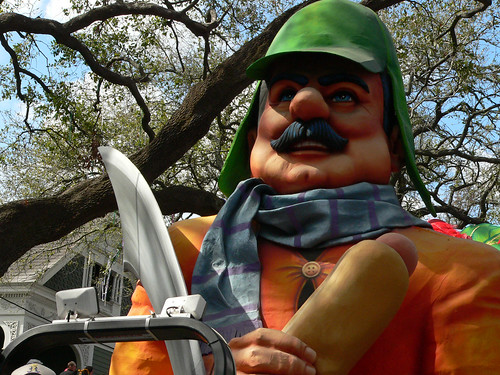 |
| An Ignatius Reilly Mardi Gras float rolls through town / Image credit: Flickr |
― Ignatius J. Reilly“I am at the moment writing a lengthy indictment against our century. When my brain begins to reel from my literary labors, I make an occasional cheese dip.”
Anthony sits at a wooden table at the Balcony Bar, a place that looks regal during the daytime but becomes the center of considerable brouhaha at night. Having had a few cocktails, we sit together eating bar food. Anthony feeds me a French Fry. Carrying a tray with hamburgers, Andrew almost runs into a cadre of revelers who are talking so loudly the entire building seems to close in on itself with the noise. We sit and attempt conversation. This is our city every night. It has been a year and a half since leaving New Orleans. Having returned home for eight days I leave again with renewed something for the Crescent City. Martin says Nola (as locals call it) is the best city. He's right.
I am an educator and a writer. I was born in Louisiana and I now live in the Big Apple. My heart beats to the rhythm of "Ain't No Place to Pee on Mardi Gras Day". My style is of the hot sauce variety. I love philosophy sprinkles and a hot cup of café au lait.
30.12.11
Disparagement of the Photograph in Proust
 |
| Man Ray. Harper's Bazaar, November 1936. |
According to Proust Photographs Point to Vanity Proust also links photography to vanity. Saint-Loup takes a photograph of Marcel’s grandmother. Noticing she puts on her best dress for the occasion, Marcel reports he feels annoyed at his grandmother’s childishness in wanting to appear her best, a fact that surprises him for he had always imagined her to be freed from vanity (v. 2, p. 500). Proust is echoing the idea that “having one’s likeness taken” is offensive to a pure concept of beauty that ought to look deeper than surface appearances. However, Proust’s aversion to photograph goes deeper than a moralistic stance against vanity. It is not an ethical deprivation which is at stake in the photograph, but rather, what Proust seems to deride is the distraction the photograph promotes and the aura of unreality it promotes. Marcel is annoyed that his grandmother will sit for Saint-Loup to have her likeness taken but she will not spend time with him, a theme that can retrace itself back to the young Marcel in Combray waiting for his mother to arrive with the long-awaited kiss. The photograph gives a false promise, one of deferral, the promise of halting time, anticipation in the guise of distraction.
Take for example the magic lantern: an analog for the disparaged photograph which is linked to the mother’s kiss episode in Combray. It is important to note the unsettling feeling aroused by the magic lantern at the start of Proust’s masterwork for it serves as a prelude to the disparagement of the plastic arts throughout the work along with a distanced awe and astonishment. Where Proust disparages he also obsesses. Where photographs are mentioned in Proust, even in passing phrases, metaphors, or allusion to photography, there is often the anticipation of themes we are more familiar with in Proust, the anticipation of a kiss, questions of real and unreal, the sensory world and the world of ideas, insight versus mere appearance.
Placed over his bedside lamp, the magic lantern entertains the boy Marcel by a show of several points of multi-colored light creating a luminous kaleidoscopic effect that evokes both the camera and the cinema, appearance, and reality, dark and light, all of which make Marcel uneasy. The iridescence is too much. Like light pouring through stained glass, the child’s magic lantern creates a “supernatural phenomenon of many colours,” causing an unreal effect to superimpose itself on the familiarity of Marcel’s childhood bedroom in Combray. Marcel is both awed and discomfited by the parade of lights the magic lantern produces, as it illuminates a story outside of Marcel’s own experience, thus limiting access to an inside inner experience. The magic lantern produces an unreal effect that shakes Marcel, the budding writer, and puts into question his desire to create uniquely and inwardly. “But my sorrows were only increased thereby, because this mere change of lighting was enough to destroy the familiar impression I had of my room …” (v. 1, p. 10). Proust’s point is to show how the luminous photographic and kaleidoscopic effects of the magic lantern discomfit and unrest the artist’s -- the novelist’s -- ability to capture reality. The magic lantern, and by extension, the play of light that is the photograph, an inscription of light on paper, is set against what novels can do, viz., what Proust feels he can do as a young artist, as a novelist.
I am an educator and a writer. I was born in Louisiana and I now live in the Big Apple. My heart beats to the rhythm of "Ain't No Place to Pee on Mardi Gras Day". My style is of the hot sauce variety. I love philosophy sprinkles and a hot cup of café au lait.
19.12.11
Marcel Proust On the Advantage of Books Over Images

"... a new book was not one of similar objects but, as it were a unique person, absolutely self-contained .... Beneath the everyday incidents, the ordinary objects and common words, I sensed a strange and individual tone of voice" (v.1, p.55-56). While photographs capture objects in the world, they are vulgar since they find what they happen to capture at the moment and so remain in quality a "commercial banality" (v. 1, p. 53).
Marcel Proust, In Search of Lost Time
I am an educator and a writer. I was born in Louisiana and I now live in the Big Apple. My heart beats to the rhythm of "Ain't No Place to Pee on Mardi Gras Day". My style is of the hot sauce variety. I love philosophy sprinkles and a hot cup of café au lait.
11.12.11
Why I Don't Write 500 Words A Day

I read once that a writer should write at least 500 words a day before any real writing occurs. To encourage writing one must write. Even if the words evoke nothing. Write. The idea is if you coax the axles of your tired mind, give it a little shake, deeper thoughts will issue forth. To me, it is an innate theory of mind that touts the philosophy that the writer must write. I say only write when you feel compelled to write. Even if it is a short thought write it down. Type it out. I refuse to submit to the notion that there is a wellspring of creativity deep inside of us and the only way to unleash it is to write a bucket load of crap first. To write is to continue upon a notion. Upon a trigger. Upon an idea. To write means to follow up on a nagging thought that doesn't go away with a nap or a dream. To say I write 500 words a day would be to lie to you. But I am not a writer who believes I must write into exhaustion. Once you get the idea. Write. Until then, do other things. Observe. Read. The best advice I can give to writers is to read. A lot. I don't just mean blogs and newspaper articles. To be a good writer read the best of what you wish to write. Not so as to emulate. It is a fable to think that to read others will rub off on you in a bad way. The anxiety of influence is there, of course. But one reads because one realizes that it has already been said, written, done before. The only hope we have as writers is to say something about what has already been said. The most freeing experience is to read a writer who puts into words a thought you've already had at some point. This revelation conjoins you with the world of ideas. The best writers enter into the history of thought by reading the history of thought. And read with a pencil. Underline. Strikethrough. Spit on. Spill coffee on it. The book. If it is an ebook or a library book buy yourself a reading notebook. If you are a young person you will never write anything that amounts to "good" for a long time. I have not written anything good yet. But I feel that I am close to writing something good. It has taken at least thirty-one years to even begin to think I could write something pitch-perfect. I have yet to stumble upon my topic. What compels me to write. Which is why I repudiate the inner writer thesis. It is not so much that what I must write is within me but more that what I want to write about has not been found yet. So, here ends my five hundred words for today. I did it for spite.
I am an educator and a writer. I was born in Louisiana and I now live in the Big Apple. My heart beats to the rhythm of "Ain't No Place to Pee on Mardi Gras Day". My style is of the hot sauce variety. I love philosophy sprinkles and a hot cup of café au lait.
Subscribe to:
Posts (Atom)