Showing posts with label review. Show all posts

14.11.11

Movie Review: Love Story

A capsule review on fragility and loss in Love Story (1970) with a special nod to love in libraries.
Ryan O'Neil and Allie McGraw in Arther Hiller's Love Story (1970) 


Yes, I must say, love that begins in a library is a trope we find in Music Man or in the fantasy of bookish nerds, so we naturally equate it with Cinderella syndrome — the woman patiently waiting for her man to appear from behind the stacks. In the 1970 Arthur Hiller film, Love Story, Allie McGraw and Ryan O’Neil butt heads at a library circulation desk; hardly the madame librarian named Marianne, or some ethereal intellectual fantasy. Ryan O’Neil, a Harvard jock, deemed “preppie” by his inimical counterpart, the black-haired brilliant musician sprung from humble Bostonian roots. The two make for a nice compare and contrast (as far as romances go). In the scene, shot in the interior of the library at Radcliffe, O’Neil attempts to check out The Waning of the Middle Ages. “Do you have your own library?” she asks, goading him, revealing the difference (at least to the viewer) between the sexes at ivy league American schools. Harvard is gendered as male: more books, more knowledge, more opportunity. Why should a man march into a woman’s space demanding their knowledge when he has his own, and more? The two argue. She wants to play. He just wants a book. The heart and spunk of the intellectual romantic comedy is born. The tropes are obvious. And we see the two soon-to-be-lovers as distinct yet compatible. The jock likes the girl’s toughness and rebellious approach. She likes his body, as she playfully says, and perhaps notices he is not put-off by her intellectual affronts. The psychology is laid out in pieces in the movie. He comes from privileged New England wealth but disdains his background. She has pulled herself up by her bootstraps and wears her intellectual and musical acumen like a badge. 

Allie McGraw projects beauty in this movie and the ability to engage in playful rapporté — not quite a femme fatale, however, since beneath her brilliance lies a fragility that marks the film and gestures towards its intrinsic theme, namely the fragile nature of relationships thwarted by circumstances often beyond our control. Despite their outward differences, the two come together because of a shared sameness. The movie takes turn portraying Ryan O’Neil’s character as vulnerable, for example when his father shows up unexpectedly at a Harvard hockey match and Allie McGraw’s character is there to support him, to hold him up. On the way to visit his parents, Ryan O’Neil eases her apprehensions about the visit. Of course, the movie is set up to be about the oscillation between loneliness and fragility. The opening shot, if I recall, is the former Harvard jock looking out onto an empty ice skating rink in Central Park. We as viewers do not know the significance of this scene until much later when we learn that our intractable, confident heroine has contracted leukemia. Preppie skates the rink in solitude while she looks on from the bleachers, both aware of the fragility of their soon to be broken apart bond. The editors chose to superimpose Allie McGraw’s image over that of Ryan O’Neil as he skates. For me, this was unnecessary for I think it dismisses the impact of the loss to come. We are reminded of the playful moments of their relationship earlier in the film: for example when both make snow angels and build a snow fort at Harvard. Director Arthur Hiller mentions in a documentary on the film, that this scene was serendipitous in that there was a record snowfall that day, but he decided to film anyway. Since he had made it clear he wanted Allie McGraw and Ryan O’Neil to portray what lovers do when they are new in love, he just had them play naturally in the snow. Here we see the two without words, without intellectual sparring, or agonizing over class difference. It is in other scenes that we see the intellectual difference between the two. She is graceful and brilliant in music and he is stalwart in achieving success cut off from the breast milk of his rich upbringing. The movie would be mediocre if we knew from the outset that our heroine will die. We only know this later; and, we can then feel for their loss. We are meant to project our own emotions and our own memories of love and love lost onto our formal lovers on screen. Perhaps this is why the movie was so popular, nominated for seven academy awards — not to forget the original score that is transcendent in its tonal representation of love and loss. I don’t think Love Story is a great film, but I do feel it would have been a lesser film if not for the work of our two stars who truly embody on screen the give and take of living with one another, the give and take, ease and struggle, life and loss, separation and link of conversation and togetherness.

18.7.11

When Seeing the Devil is Not a Matter of Good Versus Evil

I Saw the Devil
(2010) Directed by Jee-woon Kim
Starring Byung-hun Lee, Min-sik Choi and Gook-hwan Jeon
Film Still from Korean Film "I Saw the Devil" Directed by Jee-woon Kim

    It was an incongruous pairing for me this weekend: Jim Hensen's muppets and a Korean film depicting gory revenge. After previewing Hensen's charming eight minute exploration on resisting time (at the Museum of the Moving Image in Astoria), my buddy Airplane and I took in the last film showing offered in the museum's theater. I Saw The Devil is most certainly not a sight for Miss Piggy. Or for Kermit.
    If one takes Dostoevsky's Crime and Punishment to the next level it might be close to this movie. At the outset I knew it would be bloody and disturbing. The first few minutes is a graphic abduction and beheading of the protagonist's fiancé.
    Protagonist may be too strong of a word. The film calls into question the concept of villain and hero. The narrative runs revenge style. Man kills man's love so man seeks out to destroy man. The movie takes us on this horrific journey but twists it to the extent that at the end we are not sure who is good or who is bad.
    Neither apologetic nor dogmatic, director Jee-woon Kim's impeccably filmed story of sadism and torture is not a movie for the faint of heart. Hoping to rest on a human ending, this tale ends with questions disturbingly left unanswered about man's inhumanity to man.
    Revenge is bad is the film's mantra. The typical good versus evil movie usually ends with evil overturned by  the good. Not this movie. [spoiler alert] While evil does get vanquished by the plot's end, so does good.
    It seems to me after a couple of hours of maiming, blood lust, and chopped up corpses, all we are left with is the question why?
    The gist seems to be a Chinatown addendum where the path down the rabbit hole leads to only one place: a seizing, inescapable void.
C-
Image credit: filmdeviant

15.1.11

Movie Review: The Time That Remains

The Time That Remains is Elia Suleiman's autobiographical account of his Palestinian family in Nazareth who lived under the post-1948 sovereignty of Israel.
A movie review
The Time That Remains (Al Zaman Al Baqi) (2009)
Director: Elia Suleiman
Starring: Elia Suleiman, Saleh Bakri, Zuhair Abu Hanna, Samar Tanus, Ayman Espanioli, Shafika Bajjali

The Time That Remains is Elia Suleiman's autobiographical account of his Palestinian family in Nazareth who lived under the post-1948 sovereignty of Israel. The film opens with the events that led Nazareth to surrender to Israeli forces in 1948. An Iraqi soldier runs through the streets of Nazareth after the Arabs surrender. White sheets of paper rain down from the sky announcing the details of the Israeli/Arab armistice. Fuad (played by a handsome Saleh Bakri), who we later learn is Elia Suleiman's father, is suspected of distributing arms to Arab fighters during the war and is tortured.

8.10.10

Movie Review: The Social Network

It should be no surprise that a film like the Social Network would eventually be made. Again. It is a story, as you will notice, if you see it, told over and over again. But, it is a story we like to hear, a story of greed and loss. The story of a man’s quick climb to power and wealth at the cost of losing friends and intimacy has found more than one expression in American cinema. Citizen Kane anyone? Or how about The Godfather? The snapshot images of a solitary Kane whispering "rosebud" is strangely resonant with that of Mark Zukerberg clicking a refresh button for hoped for human connection.
Citizen Kane, anyone?
The Social Network is Real Enough (With Some Artistic Liberties Taken)
Now, don't go worrying about whether the plot of the Social network is accurate or not. A simple Google search will reveal some of the plot is contrived, most notably the first scene that pretends to create the imbroglio that starts TheFacebook, namely, a break-up. The film is not too slow to remind us that its protagonist is not very likable. In fact, he is a jerk. Sexist, as well, and has a penchant for younger Asian girls, albeit an unnerving social awkwardness stereotypical of boys who write programming code. Aaron Sorkin's masterpiece is not really about Facebook, per se, but rather, an opportunity to elaborate on an American myth. Sure, we will believe -- or shall I say — can believe — Mark is painted to be the kind of guy who would sell out his friends. The lawyer at the end of the films acts as the audience when she tells Mark, “Myths need a devil.” Give us — the audience — enough details and we will gladly fill in the rest.

Craving the Limelight
The indictment of Mark Zuckerberg really isn't about Mark Zuckerberg so much as it is about a fascination with greed and power. Let's say it wasn't Mark Zuckerberg who created a website called facemash.com where Harvard girls were compared online to one another by Harvard boys (22,000 page views in one night). Let us say it wasn't Zuckerberg who may or may not have posted a blog post confessing his ex-girlfriend's true bra size. Let us say it was not Zuckerberg who may or may not have called the cops on Sean Parker who was with a minor at a party with illegal drugs (with Zuckerberg in the know, but in absentia). Let us say Mark had no idea that his best friend Eduardo Saverin would be pushed out of Facebook, rather mercilessly. 

It doesn't matter. Facebook is fascinating because a lanky, unlikeable Harvard nerd made it to the top. The key term is unlikable. When we realize it was not the more courteous Saverin who brought Facebook to fame -- nor was it the Winklevoss Brothers -- or anyone else at Harvard -- we realize that Mark Zuckerberg is kind of like a contemporary version of Charles Foster Kane. What is next? Will he fight for the common man? Well, sure. He already has. Who gave 100 million dollars (or some outrageous figure) to New Jersey public schools? Mark Zuckerberg! Zuckerberg's philanthropy -- disingenuous or not -- is a necessary element in the narrative. I cannot help but think of Charles Foster Kane's historical inspiration, William Randolph Hearst and his philanthropic effort to save New Yorkers from transit fare raises. But, we know from history, neither Mark Zuckerberg or William Randolph Hearst were experts in ethical do-gooding.


Facebook as an American Fantasy of the Garden of Eden
Being sued by the Winklevoss brothers, handsome rich rowing twins from Harvard for purportedly stealing their idea of a college social networking site, Mark is happy to make them angry because, as he says, they never had the experience before of someone else stopping them from doing what they want to do. The creation of Facebook on hand is like Charles Foster Kane's beginning glory: the icon of the wealthy philanthropist who used power to shame the good ole boys. But, there is also the dark side. He betrays his friend. His only friend, Eduardo Saverin. The film takes on an uncanny color of American myth. Watching the film, I felt like I was not watching a biopic of a guy who created a social networking site I use daily, and like very much, but the story of the American Garden of Eden -- the lust for power that make such stores as John Steinbeck's The Pearl and East of Eden. The American dream also spoiled and tainted by American lust. The American trope of succesful, yet disconnected, as also embodied by the current TV character Draper in "Madmen".


This is the dilemma of the film.
How can a man create a social networking site and make billions and billions of dollars and know nothing of human nature? Knowledge of human nature does not bring in the dough. Why? Because people do not care about human nature; we care about as a gestalt, but not as something to grasp. We care about status and tags because it feeds our self-image. We like the likes and the words on our walls because it makes us feel connected when were are not connected. I don’t think Mark Zuckerberg created facebook as a huge social experiment. He created it because he realized that the site could make him famous. Which it did. Or, to put it another way, it justified him. Because he deserved it. Right. 

Parable of Genius
Steve Jobs did not create Apple in his garage because he thought it would be fun to sell computers. He had an intuition that his computers would catch on with the masses. Zuckerberg is a genius in the same way. The film the Social Network is everything about Mark Zuckerberg and at the same time, it is nothing about Mark Zuckerberg. The film is about genius and the ability to see a pathway that no one else sees and go for it. But, the film, for me at least, is also about the price of ambition. A narrative truly American. And we a jury of peers can easily judge.


The Social Network

Director: 

David Fincher

Writers: 

Aaron Sorkin (screenplay), Ben Mezrich (book)
Mark Zuckerberg Jesse Eisenberg
Eduardo Andrew Garfield
Sean
Justin Timberlake
Cameron/Tyler Armie Hammer
Divya Max Minghella
Erica Rooney Mara
Marilyn Rashida Jones

Columbia Pictures presents a film directed by 
David Fincher. Written by Aaron Sorkin, based on the book The Accidental Billionaires by Ben Mezrich. Running time: 120 minutes. Rated PG-13 (for sexual content, drug and alcohol use and language).
credits © Roger Ebert

27.5.10

Movie Review: World's Greatest Dad

Read a movie review by Greig Roselli about Bobcat Goldwaithe's dark comedy World's Greatest Dad (2009).
Two scenes are striking in Bobcat Goldwaithe's World's Greatest Dad (2009). THE FIRST is the scene where Lance Clayton, a beleaguered middle-age writer-cum-high school poetry teacher (Robin Williams) finds his strangled son, dead in his bedroom. The scene is doubly jarring for the viewer because, one, the first fifteen minutes of the film deliberately sets you up to despise the kid (Daryl Sabara, played with an acute douchebag factor). Kyle curses like a sailor, looks at scat porn, calls girls at school whores, proudly glorifies his own insouciant stupidity, uses his dad and his best friend Andrew to his own benefit, and is pretty much openly non-repentant about his deeds -- to the point of rebuffing every ounce of care his dad, Lance, has to offer.
     Second, is the cause of the boy's death (basically he dies via auto-eroticism). Go figure. Goldwaithe goes through extensive pains to make sure you absolutely hate this kid -- but at the same time -- when he is found in his bedroom, despite the embarrassing circumstances -- the viewer feels for Lance and the grief over his dull, insipid son. Even a douchebag son's death elicits authentic catharsis. Wow. I don't think I've seen this in cinema in a long time. I think this is partly due to Williams' engaging performance. Williams is an actor who can make you identify with the absurd. Think of The Night Listener, for example (which has eerie parallels to this film). The entirely silent soliloquy of finding the dead boy, checking to see if he is alive, releasing him from his makeshift noose, and mourning over his dead body was a genuine cathartic moment.

2.11.09

Software Review: Google Voice

Google has entered the tele- communications realm with its introduction of Google Voice, a service created by Google's addition last year of Grand Central, a nifty feature that transcribes voicemail messages and cloaks all your phones and telecommunication devices under the umbrella of one number: a Google number. 
     In effect, you can give out one number to all your buddies, colleagues, friends or whoever and all your phones can be connected seamlessly. Also, you can send free SMS and have voicemails transcribed for you (also, available by other services, such as Callwave).
     I had read about the service at least a year ago when Google first acquired Grand Central but was only giving the service to customers by invitation only. Alas, I was not one of the chosen few. Ugh.
    So, I was happy to discover one day, a message in my Gmail inbox that Google Voice was now available for me to sign-up.
    I would love to use the full functionality of Google Voice but, because of a move by Apple to pull the plug on Google Voice on the iPhone, I can only use the service through my computer. I am a loyal Apple fan, but here, Apple has sold itself to AT&T. Google had created a Google Voice app for the iPhone, but Apple deleted it from the Apple store.
    Personally, I think Apple's move was a bit draconian. It would be like if Microsoft did not allow you to download Firefox onto your computer and forced you to use Internet Explorer.
    But don't worry, in a recent blog post, David Pogue assures us that Google will eventually develop a web app to counteract Apple's icks-nay of its newest FREE gadget. Now, you can only use Google Voice on its android phone or on a blackberry, on your home computer, or on a web app compatible device. But the web app does not work yet on the iPhone. Just a matter of time.
    But, why is Google Voice so cool?
    Well, it is like having CallWave, Skype and Gmail all rolled up into one. I hate listening to voicemails and would just rather read them. Also, I am an addict when it comes to new digital features. Also, I am a proponent for Open Source. Apple should not decide how I access information and what platform I use to do so.
    In the meantime, you can call me through your computer until I get Google Voice, fully.*

*This functionality has been disabled.

4.9.09

Software Review: Reasons Why I Like Snow Leopard (and three things I am still waiting for)

In this blog post learn lots of reasons I really like the new Mac OS X operating system, Snow Leopard.
  • The colors on OS X have always been clean but Snow Leopard’s color scheme is purer. Or is it just me?
  • The new preview rocks! I can now copy from a PDF document that has two columns without copying both sides! Wow. Thank God for small favors.
  • I love being able to browse through files easily to find what I want; now I can even flip through a PDF or watch a movie within the icon. Now, that is just freakinglicious.
  • More room! I just regained seven gigabytes of hard drive space. More room for True Blood and Fraggle Rock!
  • The best new addition to Snow Leopard is ummmmm ... I love new editions! Does that count?
  • Price! $29.99 if you already own Leopard
:-( Third party apps really suffer. I am afraid to use Onyx or Typinator since I read online that many developers have not yet souped up their programs for Snow Leopard.

:-( I wish they would have made Leopard like this the first time around.

:-( And come on: Snow Leopard? How lame. Although it is better sounding than Windows 7.

:-( I know there is a new tweak to services but I am not sure what it is. Urggghhh. And I am not a big fan of stacks. I thought there would be more manipulability (if that is a word).

10.8.09

Movie Review: Some Like It Queer

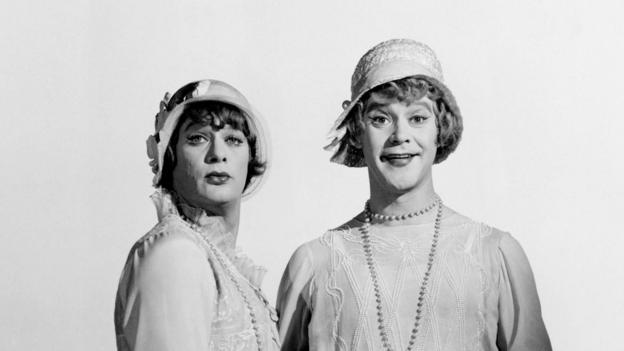
Some Like It Hot — Directed by Billy Wilder — Starring Marilyn Monroe, Tony Curtis, Jack Lemmon, and Joe E. Brown
    Some Like It Hot (1959) directed by Billy Wilder cleverly uses musical language to code for queer behavior. I will admit I had queer on my mind when Taryn called me and said, “Hey, Greig, they’re playing Some Like It Hot at the Prytania Theater.” I said to her, “I cannot wait for a gender-bender adventure!” The theater is a one-screen cinema that plays blockbusters at night and classics in the daytime. The house’s proprietor, Mr. Rene Brunet, a sweet, intelligent geriatric, bemused us with some benign trivia about the film. When he talked about Marilyn Monroe I wanted to quote Roger Ebert, who said of the star: she’s "Poured into a dress that offers her breasts like jolly treats for needy boys.”
    But, after Mr. Brunet gave his spiel he motioned the camera guy — “Hey, Robert get those melodies rolling!” — and played “Let’s All Go to the Lobby” before the show started. Seated in a nearly full house, as if we were back in 1959, Bugs Bunny gave his last grin and the feature began.
    The black and white film is covert homosexuality created under a suspicious McCarthy era period posing as a comedy of errors murder mob mystery — the cross-dressing so seamlessly dropped into the plot as to seem virtually harmless even to the most suburban, collected type. Seeing the film fifty years after it was made, it is easy to see the sex beneath the subtext. Almost every line is a double entendre if you can catch it quick enough. Daphne (Jack Lemon) proposes a cross-dressing scheme to Josephine (Cary Grant) to get them out of debt in circa 1920s Chicago. 
    The rest of the movie is all out drag. Let me just say this about the film: Daphne is queerer than Josephine. If you know the film you know what I mean. If you don’t know the film, then you are in for a treat and I won’t spoil the uproarious ending. Josephine resists until both are found by the mob as witnesses to a murder. Donning a wig and a dress, Josephine and Daphne take a train to Florida to join "Sweet Sue's Society Syncopaters."
    Ostensibly a pair of straight guys has to save their asses dressing up as women, retaining their straight status only by the extension of voluptuous Marilyn Monroe. Without her Daphne is a drag queen in love with a millionaire played expertly by Joe E. Brown and Josephine is a dominatrix queen with a penchant for saxophones.
    It is here we hear the film’s title, “some like it hot,” when Jack Lemon’s character refers to the women’s syncopated rhythm as “hot.” I cannot help but think the word hidden beneath the word is “queer.” Plain Jane straight people probably prefer un-syncopated tunes, but we queers like our beats syncopated! Some guys and girls like it different than other guys and girls: they like it hot, suggesting breaking musical boundaries is akin to crossing over into sexual taboos. 
    Geraldine warns Daphne not to sleep with Sugar, but in the end, it is Josephine wooing Sugar and Daphne running with the girls on the beach enjoying his womanhood. Cary Grant, with angular lines and a pair of succulent lips, is a more beautiful woman than Jack Lemmon’s less than beautiful ogee and awkward broad shoulders Marilyn Monroe seems to admire!
Some Like It Hot is an example of queering straight.

26.6.09

Reference Book Review: First Fun Encyclopedia (Available as a Searchable Database on EBSCOhost)

First Fun Encyclopedia
First fun encyclopedia
     Targeted to primary school children and hosted on the electronic databases MAS Ultra - School Edition and Master File Premier, First Fun Encyclopedia was published by Mason Crest in 2003 and edited and written by Jane Walker. The book is part of the series First Fun Reference Set which includes "First Fun Atlas," by Andrew Langley; "First Fun Dictionary," by Cindy Leaney; and "First Fun Science Encyclopedia," by Brian Ward. 
Available on EBSCO
     EBSCO only has the encyclopedia available digitally for now. The entire encyclopedia is available as HTML full text with graphics. The EBSCO version has 118 entries arranged alphabetically. Each entry has a persistent link feature available so users can email or post links back to the entry. The encyclopedia is searchable and references are cross-linked. 
Encylopedia Articles are Written for Young Readers
     Categorized under the subject heading "Youth & Children's Interests" the text is written at a LEXILE rating of no more than 730. To give an idea of how the book is arranged the "Ocean and Seas" entry also directs users to the "Animal Kingdom" entry. For vocabulary skills, entries include a word box related to the subject with short, simple definitions. Some entries include a word game or puzzle for fun. Each entry has high-resolution graphics to accompany the text that are instructional rather than decorative. The "Fish" entry, for example, has an illustration of a fish with labels identifying the essential anatomical parts. The entry on "Trains" includes graphics of different types of trains — subways, bullet trains, steam trains, and so forth. The entry on "Homes" describes tall homes, tent homes, and houses in rows. 
      No entry is more than 400 words.
Create Non-Fiction Text Sets
Teachers can use the entries from the First Fun Encyclopedia to create text sets for their classrooms. For example, if an English Language Arts teacher plans to teach a unit on Carl Hiassen's novel Flush, a book that takes place in Florida, then the teacher can pre-select non-fiction articles to supplement the reading. Have kids read about the sealife of Florida, or about ecology, and environmental protection efforts to create sustainable habitats for animals.
Source: Walker, Jane. First Fun Encyclopedia. Philadelphia: Mason Crest, 2003. Internet resource.